Mastering Root Cause Analysis (RCA) & CAPA Systems in Food Operations
An advanced masterclass guide on moving beyond symptom-level corrections to implement permanent preventive actions using the 5-Whys and Ishikawa methodologies.
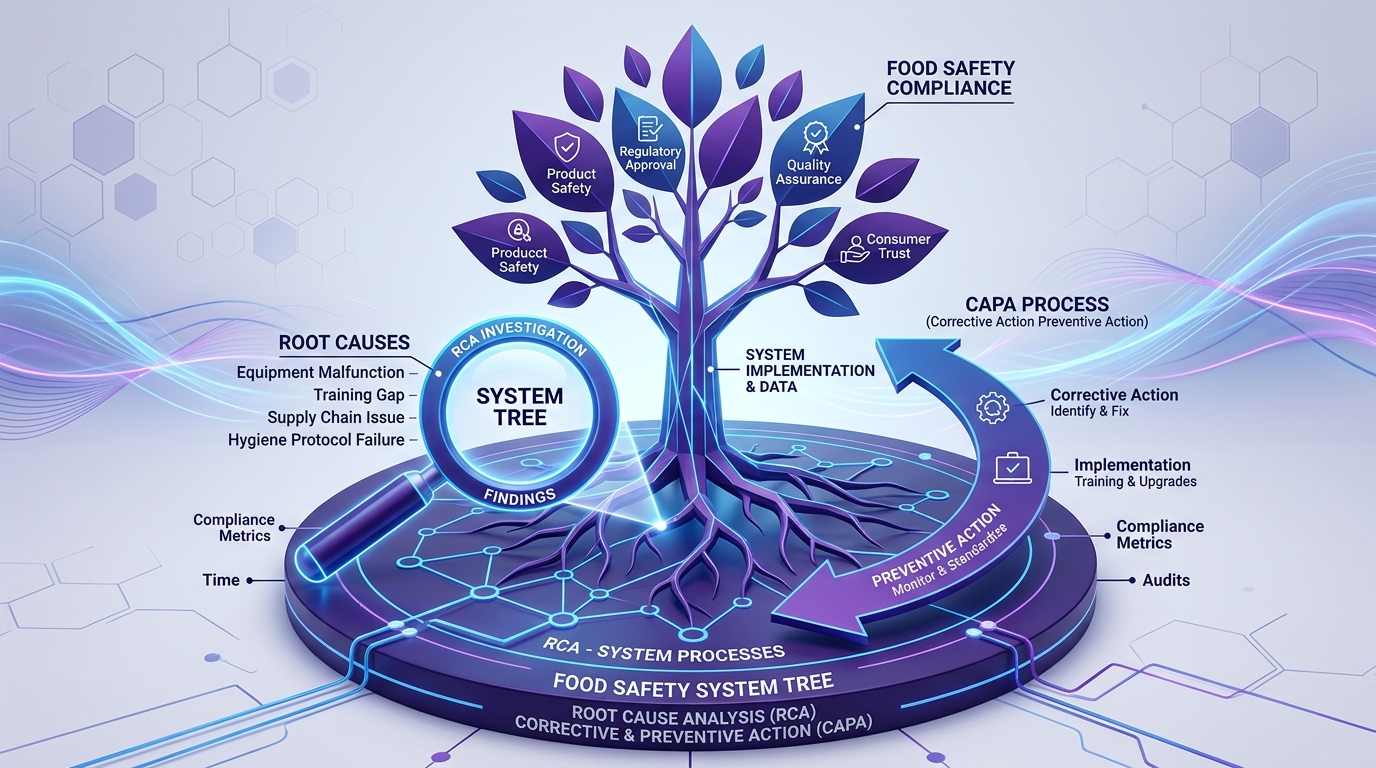
1. The Auditing Paradigm: Symptom vs. Root Cause
In professional food safety management, confusing a symptom with its root cause is the most common reason violations recur. A symptom is a visible indicator of failure (e.g., 'Sanitizer unit is out of service' or 'improperly cleaned casserole'). A correction is the immediate fix (e.g., 'retraining staff' or 'cleaning the unit'). However, the Root Cause is the latent system failure (e.g., 'lack of preventive maintenance contracts' or 'insufficient supervisor validation protocols'). Without identifying and correcting the root cause, systemic recurrence is mathematically guaranteed.
2. The 5-Whys Deep-Dive: Systemic Inquiry
The 5-Whys method is a systematic, iterative interrogative technique used to explore the cause-and-effect relationships underlying a particular problem. For instance, if an oven door fails to close: 1. Why? The door hinge is bent. 2. Why is it bent? Technicians forcefully closed it because the latch was loose. 3. Why was the latch loose? No preventive inspection checked physical latch tightness. 4. Why was it not checked? The PM checklist only verified heating elements. 5. Why? The equipment specifications were not fully integrated into the preventive maintenance planning software. This progression shifts the corrective action from replacing a latch to a comprehensive review of maintenance database templates.
3. Implementing Ishikawa (Fishbone) Diagrams for Multi-Factor Failures
Complex failures in food manufacturing require a multi-dimensional approach. The Ishikawa diagram divides variables into categories: Manpower (training, competency), Methods (procedures, HACCP flow), Machines (equipment calibration, suitability), Materials (supplies, chemicals), Measurements (thermometers, testing kits), and Mother Nature (environment). For example, finding raw salmon and bread in the same counter freezer involves Machine limits (lack of storage capacity), Methods (poor separation guidelines), and Manpower (lack of allergen/separation awareness). Creating a Fishbone visualizes how these factors interact to allow systemic remediation.
4. The CAPA Closed-Loop Validation Process
An effective CAPA program requires a closed-loop system: 1. Immediate Correction (Quarantine, clean, adjust). 2. Root Cause Identification (5-Whys, Fishbone). 3. Action Plan Creation (Owner assign, timeline). 4. Implementation (Installing hardware, training). 5. Verification of Effectiveness: After 30/60 days, an independent auditor must verify the issue has not recurred. Only when the verification proves success can the CAPA request be formally closed in the database.
Want To Apply This To Your Facility?
Contact us to turn these concepts into a field assessment and a practical action plan.
Contact Us