Advanced Cold Chain Management: Thermal Kinetics and Calibration Physics
A deeply technical analysis of pathogen kinetics in the danger zone, refrigeration thermodynamics, and high-precision thermometer calibration.
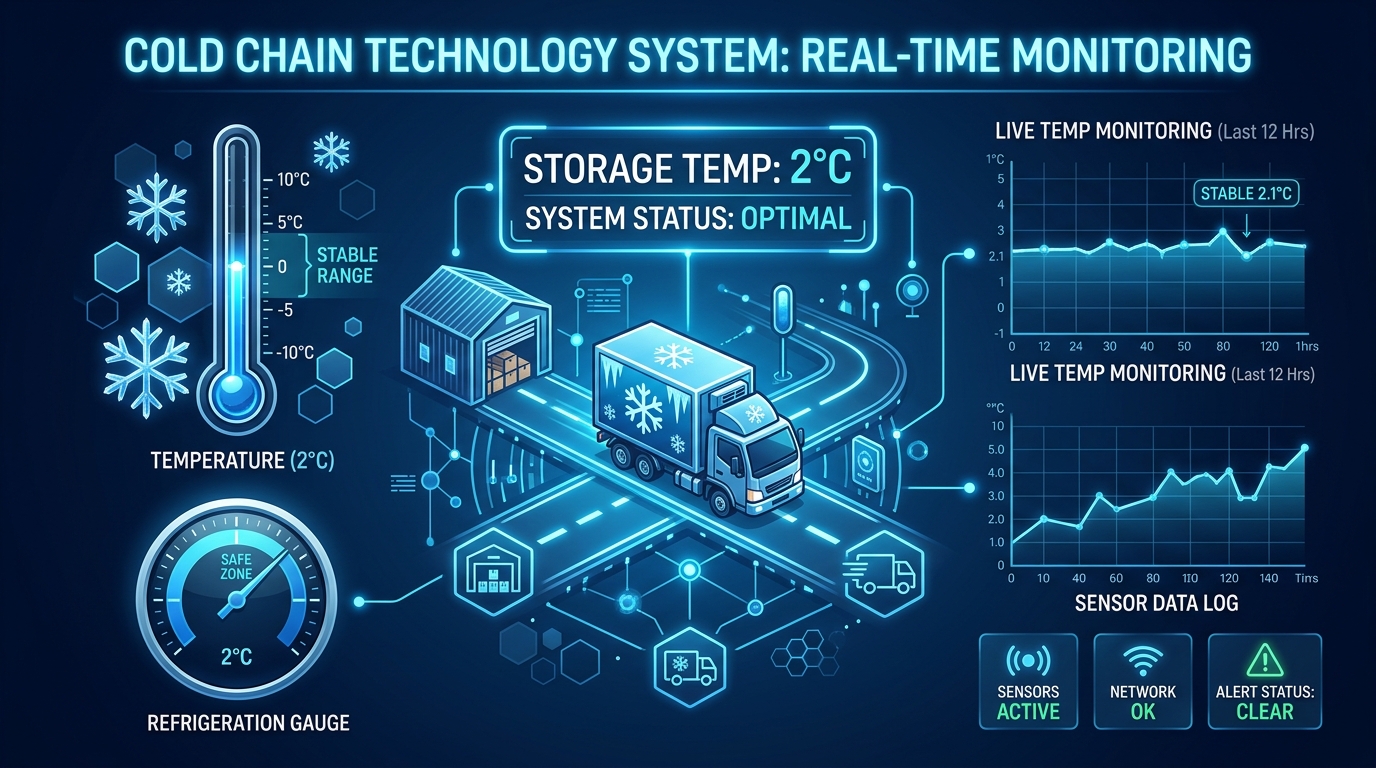
1. Microbiological Kinetics in the Temperature Danger Zone
The temperature danger zone (5°C to 60°C) is not a static warning; it is a mathematical curve representing exponential bacterial growth. Pathogens like Listeria monocytogenes can grow at refrigeration temperatures, but their replication speed increases drastically above 5°C. At room temperature, Escherichia coli and Salmonella enterica have a generation time of less than 20 minutes. Maintaining strict cold holding limits (< 4°C for chillers, < -18°C for freezers) is the primary thermodynamic barrier to prevent pathogen concentration from reaching infectious dose thresholds.
2. Equipment Thermal Profiling and Core Temperature Auditing
Auditing cold storage requires checking beyond the cabinet's digital air probe. Air temperature cycles dynamically during compressor operations and defrost phases. Core food product temperature is the true metric. When auditing freezers holding critical items (such as gelato or seafood), the auditor uses a calibrated infrared thermometer for packaging surfaces and a core insertion probe for inner mass. If the gelato freezer displays -9°C, the product is in a transition zone where ice crystal deformation occurs, promoting quality degradation and surface pathogen vulnerability. Immediate quarantine is mandatory.
3. Physics of High-Precision Thermometer Calibration
Thermometers drift over time due to mechanical vibration, thermal shock, and battery degradation. Two physical constants are used for field calibration: the Ice Point (0°C) and the Boiling Point (100°C). For ice point calibration, the container must be filled completely with crushed distilled ice and water to form a dense slushy mixture (adiabatic system). The sensor probe must be fully submerged without touching the container walls. The reading must display 0°C ± 0.5°C. For boiling point calibration, atmospheric pressure and altitude must be calculated, as water boils at lower temperatures at high elevations.
Want To Apply This To Your Facility?
Contact us to turn these concepts into a field assessment and a practical action plan.
Contact Us